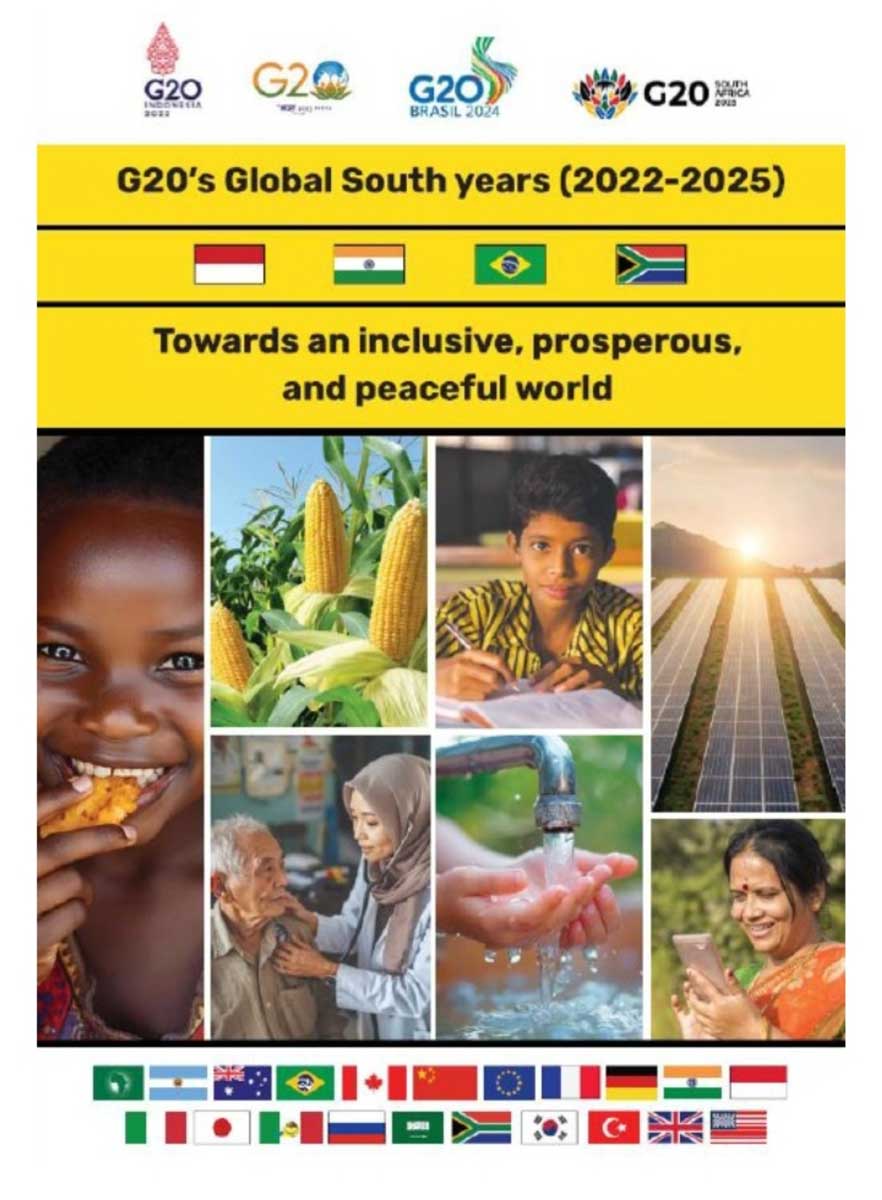
G20’s Global South Years (2022-2025): Towards an inclusive, prosperous, and peaceful world (1st ed., Vol.1).
By Syed Munir Khasru, Amitabh Kant, Zane Dangor, Edi Prio Pambudi, & Marianna Albuquerque.
Published by IPAG Asia Pacific (2025)
G20’s Global South Years (2022-2025) takes a closer look at what has been termed the Global South Moment in G20 leadership by analysing how the four nations – India, Indonesia, Brazil, and South Africa – leveraged their presidencies to centre development, equity, sustainability, and reformed multilateralism at the heart of international economic cooperation.
For the first time, four consecutive presidencies from the Global South led one of the world’s prime forums for international economic cooperation. The sequence signalled a shift in the way global governance operates, with priorities that command attention and voices that shape the international economic agenda.
Pioneering the Global South moment in 2022 was Indonesia. Indonesia’s presidency confronted immediate crises, pandemic recovery, and geopolitical tensions while laying the foundations for health resilience and just energy transitions. India (2023) expanded the aperture, securing the African Union’s (AU) membership in the G20 and championing digital public infrastructure (DPI) for democratising technology for development. Brazil (2024) launched the Global Alliance Against Hunger and Poverty, endorsed by 82 countries, the AU, the European Union (EU), and nine international financial institutions. South Africa (2025) consolidated this trajectory, centering African industrialisation priorities, debt sustainability mechanisms, and capital cost reviews, which exposed how the financial architecture systematically disadvantages developing economies.
The book not only provides a country-specific analysis of each presidency, highlighting notable achievements and challenges, but also offers a unique approach by combining insider perspectives from the actual Sherpas (presidential representatives) and senior officials who led the four G20 Global South presidencies. For instance, the book features a detailed account by Amitabh Kant of his journey as a Sherpa during India’s 2023 presidency year.
What distinguishes the Global South presidential cycle is not simply geographical diversity in leadership but a deliberate intellectual and diplomatic thrust to reframe global governance around equity and structural transformation.
Consequently, a Troika (made up of the current, immediate past, and next host countries) strove to set an agenda that moved beyond macro-stability toward inclusion and systemic reform. The Troika mechanism is often dismissed as ceremonial. Yet under the Global South’s leadership, it became a vehicle for thematic continuity. For example, India worked closely with Indonesia to focus on food security and carry forward the Financial Intermediary Fund for Pandemic Prevention, Preparedness and Response, popularly known as the Pandemic Fund, worth $ 2 billion, with $885 million awarded across 47 projects in 75 countries. Brazil coordinated with India to transform DPI from a national showcase into a global repository, while South Africa entered its presidency already embedded in discussions on debt sustainability and critical minerals because its Sherpa team had participated in shaping those files in the preceding years. This collaboration also generated positive spillovers for strengthening cooperation in other forums, such as BRICS and the Three Basins Summit.
The Global South presidencies introduced several thematic innovations that distinguish them from their predecessors. First, they consistently prioritised inclusive growth and development outcomes over narrow measures of economic efficiency. This has translated into increased attention to employment creation, skills development, and social protection systems as legitimate subjects for international economic cooperation. Second, they integrated climate action with development priorities in unprecedented ways. Rather than treating environmental sustainability and economic development as competing objectives, these presidencies framed climate action as essential for long-term development success, particularly for vulnerable developing countries. Third, they championed the reform of international financial architecture, including multilateral development banks, debt treatment mechanisms, and international tax cooperation. This agenda reflects shared frustrations with existing institutions’ limited capacity to effectively address contemporary development challenges. Fourth, they elevated digital transformation as a development priority, recognising both the opportunities and risks that digitalisation presents for developing countries. This included initiatives on digital skills and digital governance frameworks that protect privacy and promote inclusion.
In addition to these developments, a key landmark of the Global South moment is the inclusion of the AU as a permanent member of the G20, approved under the Indian presidency and implemented during that of Brazil – thus acknowledging Africa’s important role in the global economy and supporting the AU’s aspirations under Agenda 2063.
Africa’s G20 moment is also evident in how the South African presidency placed African concerns, namely debt, minerals, digital systems, and agriculture, at the centre of deliberations. This is reflected in G20 statements that have increasingly adopted African concepts such as debt justice, equitable artificial intelligence, governance, and local mineral beneficiation.
Likewise, examples of success include completing Zambia and Ghana’s debt restructuring, mobilising at least $10 million in new development financing, launching two refining ventures in Africa, securing more than $1 billion for African agriculture, and ensuring that the AU is explicitly recognised in the International Monetary Fund (IMF) and World Bank reform language.
Unfortunately, these remarkable achievements coincided with unprecedented challenges. For instance, geopolitical divisions continued to make consensus in decision-making fragile, while limited institutional capacity across parts of Africa slows down the implementation of communiqués into policy. Of particular concern is the increase in incidents where, when consensus is elusive or unattainable, it results in chair summaries rather than joint actionable communiqués. Creditor coordination remains inconsistent, and the tension between national industrial policies and the principle of open trade remains unresolved. Furthermore, rising food and energy insecurity, partly linked to these geopolitical conflicts, threatens to reverse decades of development progress.
As a result, the authors state that Africa’s G20 moment is both symbolic and practical. The symbolic nature lies in Africa’s visibility in global governance higher than at any point in history, and it is practical because real deliverables are achievable despite the challenges.
The authors also reiterate that the entire forum’s continued significance depends fundamentally on its capacity to evolve from producing declarative communiqués to generating measurable and adequately resourced solutions to pressing global challenges. Success will require presidencies that can balance aspirational goal setting with a realistic assessment of implementation capacity, political constraints, and resource availability.
They further emphasise that overcoming challenges requires collaboration with key international organisations that facilitate global partnership such as the United Nations (UN), World Bank, IMF, World Trade Organization (WTO), and the Organization of Economic Cooperation and Development (OECD). Although the G20 has no direct mandate over international institutions such as the UN, it provides political space to press for change.
Evidently, the four years of Global South leadership have shown that meaningful change is possible, even in an era of geopolitical division and economic uncertainty. The question put forth by the authors is whether the international community will build on this foundation or allow the moment to pass without consolidating the innovations that have begun. The choice will determine not only the G20’s future relevance, but also the prospects for a more inclusive, sustainable, and equitable global order in the decades to come.
This book is suitable for officials who hold key positions in government and politics, the private sector, academia, the civil service, non-governmental and pan-African organisations that set economic agendas, and those who advise in policy advocacy.

Sarah Nyengerai is an academic and freelance writer based in Zimbabwe with a strong passion for social, cultural, economic and political issues that affect women. She believes literary works form the foundation for the dialogue required to sustain momentums of change and aims to bring attention to such matters. A member of NAFSA (Association for International Educators) and Forum for African Women Educationalists (FAWE), Sarah is actively involved in the advancement of education for women.