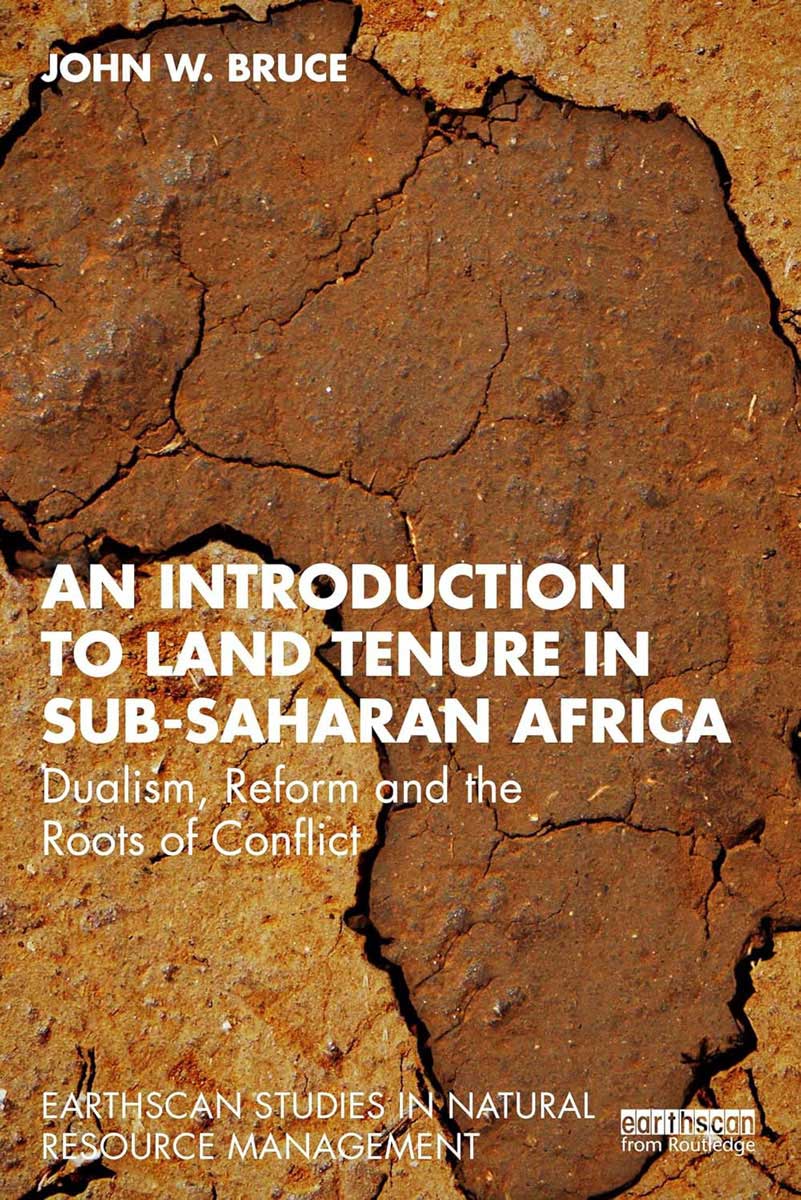
An Introduction to Land Tenure in Sub-Saharan Africa: Dualism, Reform and the Roots of Conflict, Published by Routledge (2026)
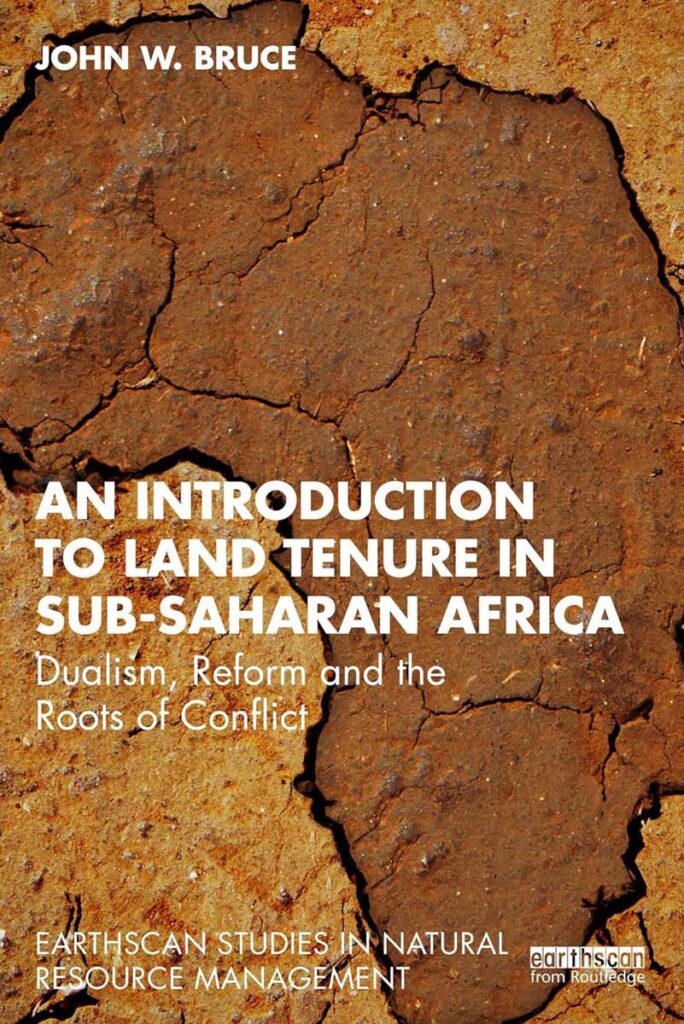
In An Introduction to Land Tenure in Sub-Saharan Africa, John W Bruce examines the evolution of customary land tenure and the complex challenges African nations face in land reform.
A defining feature of post-colonial land tenure across most African states is the nationalisation of all or most of their land and natural resources. Reforms preceding independence focused on customary tenure, seeking to address local inequities in ownership and use, including unequal access and the marginalisation of certain groups.
Bruce points out that in present-day Africa, policymakers must contend with increasingly diverse tenure landscapes, with land under a variety of tenure domains. These domains include:
- In areas of smallholder and herder agriculture where customary land tenure largely persists, traditional authorities still manage land allocation, but national law offers minimal or zero effective protection.
- Areas in which the government has used its legal ownership of land to take that land from traditional users and allocate it to larger-scale producers, foreign and domestic, on long-term contractual instruments such as leases and concessions.
- Areas in which customary land tenure systems have evolved and continue to evolve under pressures from larger market economies, with land acquiring market value and being bought and sold, with or without legal recognition of the new right.
- Areas in which customary land rights have received legal recognition and legal protection, either as customary rights, rights of ownership or statutory use rights conferred by the state on smallholders/herders using legally government-owned land.
In most countries, the tenure categories highlighted are present, but with widely differing amounts and in different geographical configurations, reshaping the structural landscape of African agriculture and augmenting both collaborative and competitive interactions between concessionaires and customary landholders.
For instance, featured in the book, Nigeria, Senegal and Mali, and later Sudan, Ethiopia and Uganda, committed to land that had been in private ownership in their nationalisation agenda, converting the title of the owner to a long-term leasehold or use right, with Uganda being the most recent to institute private ownership. In Senegal, particularly, land was nationalised, and provisions were made to issue certificates of use rights upon request by the landholder, albeit with sporadic conversions and low uptake by landowners. Hence, proving that the ‘individualisation to a state-granted use right’ tenure reform model varies.
Conversely, Kenya took a different path from most by embracing colonial reforms intended to replace customary ownership with private land ownership. This destruction of customary tenure meant Kenya considered land as a source of authority and power more directly than nationalisation approaches elsewhere, thus influencing the tenure reforms now dominant across Africa. Simply put, Kenya’s post-independence land tenure reform was to confirm existing boundaries of parcels held by individual landholders under custom (rather than assigning customary land tenure) and provide a marketable title that awards the holder statutory private individual ownership.
In Rwanda, the concept is largely the same; only the marketable “titles” are 99-year, renewable state-issued leaseholds. An option in most countries in Anglophone Africa, it has only recently been replicated for rural land reform in Francophone countries, which initially chose to decentralise land administration and supervision of agricultural land use rather than altering tenure.
Bruce points out that several additional factors contribute to land tenure confusion. Globally we are in a time of rapid change in land use and land rights, driven by a variety of factors but most significantly by a sudden growth of pressure for change from overseas. For example, due to the global food crisis, predicted in 2007, international demand for cheaper land and labour in developing countries has peaked.
Subsequently, a growing movement (before African countries find their footing with tenure models and reform) is the issue dubbed “The Great Land Grab”, often termed “recolonisation”.
The Great Land Grab is a pejorative term used for the extensive contracting by developing governments of state-owned land to foreign investors for export agriculture, expelling in the process those who held and farmed the land by customary right. The concession process reaffirms the state’s ownership of the land, ignoring customary claims to ownership and depriving communities of land use. Concessions typically provide investors with long-term (usually several decades) land use rights, while the state remains the owner. The private customary rights of local inhabitants are lost in the process; their loss of possession leaves the state secure in its claim of ownership over the land.
This confirms that customary rights remain poorly protected, if at all, by national land laws. Excluded from formal markets by both traditional and national policies, customary land is cheap to acquire. Investors often bypass available freehold land to target customary tenure, exploiting its low or zero cost via state abuse, compulsory acquisition, or illicit purchases from chiefs and other traditional rulers. Common lands, such as rangelands or forests, are frequent targets. This relative ease of large-scale acquisition has made Africa the continent most affected by the “land grab”.
Despite the grim picture painted by the author, the book notes important exceptions. Kenya, Uganda and South Africa retain major areas of land under freehold ownership, though only Kenya has expanded this substantially. All three still hold land under customary tenure. Similarly, Mozambique, Botswana, Liberia and Ghana have conferred legal recognition of customary tenure, granting it status comparable to state or private ownership.
Despite Africa’s discouraging record on tenure reform, the author urges governments not to abandon the issue. As a way forward, the book does not propose an overall customary land tenure reform strategy; that would ignore the fact that details of local contexts matter greatly in planning any tenure reforms. Instead, it suggests approaches, some more novel than others, for reformers familiar with specific contexts. One is using international conventions to protect the land rights of people facing discrimination, like women or vulnerable groups such as indigenous peoples, under the ILO Convention 169. The Convention applies only where communities self-identify and maintain a traditional, land-dependent way of life, thereby benefiting ethnic minorities such as forest dwellers and hunter-gatherers.
Another proposal is that governments should recognise traditional land-holding communities as owners and allow community governance structures to sell the land. This could direct much of the land’s growth in value to local communities. Furthermore, even if governments refuse to transfer ownership, offering long-term leasehold rights enables communities to sell part of a leasehold to enhance its marketability. In turn, the state retains land ownership while communities use the rental income for development. Such processes must be managed by a community institution with a clear legal mandate.
The book’s strength lies in Bruce’s personal accounts, featured as case studies, from his time as a researcher in mostly East and West Africa. The case studies aligned with each topic anchor the conclusion of each chapter. His passion, both emotional and palpable, emerges as he addresses Africa’s land tenure struggles, acknowledging that no system is ideal and that winners and losers are inevitable. He echoes that the right tenure system is one that best serves society’s interests and does so equitably.
His book is suitable for students, scholars, and practitioners in government, non-governmental organisations, and the private sector who are keen to understand land tenure in African development.

Sarah Nyengerai is an academic and freelance writer based in Zimbabwe with a strong passion for social, cultural, economic and political issues that affect women. She believes literary works form the foundation for the dialogue required to sustain momentums of change and aims to bring attention to such matters. A member of NAFSA (Association for International Educators) and Forum for African Women Educationalists (FAWE), Sarah is actively involved in the advancement of education for women.