
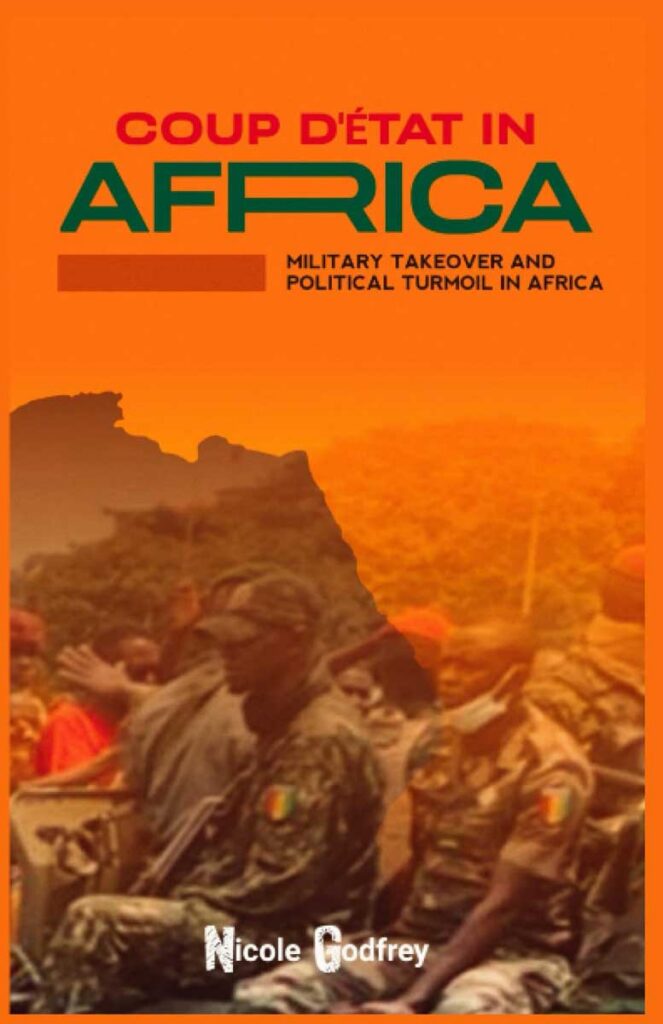
Independently published (2023)
In Coup D’état in Africa: Military Takeover and Political Turmoil in Africa, Nicole Godfrey studies the historical context of coups d’état, highlighting their causes and consequences, with a primary focus on Mali, Niger, Gabon and Côte d’Ivoire.
Godfrey states that to understand the complex network of coups in Africa, one must venture deep into the historical roots that have incubated these crises by examining the various variables that have fuelled the recurring trend.
She further states that the frequent occurrence of coups d’état is closely tied to the continent’s complex colonial legacy, given that the aftermath of decolonisation saw the emergence of numerous newly independent nations struggling to establish stable governance structures.
Colonial rule often left a fragmented political landscape, with arbitrary borders. These borders rarely respected the ethnic, cultural, and religious realities on the ground, fostering conditions ripe for political unrest. So, as post-colonial nations grappled with the daunting task of nation-building, the absence of a strong institutional foundation and the legacy of divisive colonial policies became breeding grounds for political instability.
Godfrey’s historical assessments of Mali, Niger, Gabon, and Côte d’Ivoire shed light on the diverse factors that drive political upheaval.
In Mali, one of the most notable coups happened in March 2012 and was led by Captain Amadou Haya Sanogo, who ousted President Amadou Toumani Touré. The coup was motivated by allegations of corruption, mismanagement, and the government’s perceived inability to address the Tuareg rebellion in the north. The repercussions of this coup reverberated across the region, culminating in a French-led military intervention to combat Islamist militants in northern Mali.
Similarly, in February 2010, Niger’s President Mamadou Tandja was overthrown in a coup led by Lieutenant General Salou Djibo. This coup was driven by Tandja’s controversial bid to extend his presidency and concentrate power.
It is worth noting that Niger has had five coups since its first in 1974, following independence in 1960, with the most recent in 2023. Niger’s coups are often driven by constitutional manipulation and political power struggles. The nation’s vast mineral wealth, particularly uranium, has also attracted international interests and contributed to its political volatility.
Gabon’s first military coup happened in 1964, led by Lieutenant Jean-Hilaire Aubbame, and ousted President Léon M’ba. Omar Bongo later seized power in 1967 and ruled for more than four decades until his death in 2009. Since then, Gabon has seen two more coups: one in 2019 and another in 2023. All three coups trace back to the same core issues: the Bongo family’s dynastic rule, economic inequality, a lack of political pluralism, and recurring electoral fraud. Gabon’s oil wealth also helped sustain the Bongo family’s authoritarian rule by funding the system and shielding it from pressure.
In Côte d’Ivoire, major military upheavals took place in 1999, 2000, 2002, and 2012. The 1999 coup was the most notable when General Robert Guéï ousted President Henri Konan Bédié. As Godfrey notes, it stemmed from economic grievances, political exclusion, and ethnic tensions. Across all four coups in Côte d’Ivoire, the pattern is the same: economic hardship, grievances within the military, and deep political and ethnic divisions. These were aggravated by competition over cocoa and coffee exports, which are central to the economy.
Beyond the immediate impact of overthrowing governments, coups have a profound and lasting effect on political stability, economic development, human rights, and mass displacement, among others.
Marginalised and vulnerable communities, such as women and children, are often disproportionately affected by human rights abuses during and after coups. Sexual violence, forced displacement, and the recruitment of child soldiers are common outcomes of political upheaval.
Forced movement, both within countries and across borders, creates a refugee crisis as people flee their homes. To escape the violence and chaos, victims often seek refuge in neighbouring countries or in makeshift camps at home. This places immense strain on host countries’ resources, infrastructure, and social services. It also fuels tension between host communities and displaced populations, worsening regional instability. The displacement of skilled professionals and disruption of education further erode human capital development and economic growth in affected regions.
Ironically, the factors that trigger coups often become their repercussions, creating a vicious cycle. Ultimately, this means that, unless well-managed, coups don’t solve anything; they simply reset the problem. Godfrey illustrates this well in the book: coups framed as attempts to restore order or correct injustices usually end up producing more turbulence and uncertainty.
One of the main ways this happens is repression, as coup leaders often rely on repression to stay in power, using common tactics like censoring the media, suppressing dissent, and restricting freedom of assembly to silence opposition. Arrests of individuals who do not comply frequently escalate into severe human rights abuses like torture. When this becomes routine, the rule of law and democracy are eroded.
Ultimately, the abrupt removal of a government, even one deemed corrupt or ineffective, creates a power vacuum with far-reaching effects, intensifying political rivalries and putting civilians at risk.
Godfrey proposes several strategies to tackle the persistent threat of coups and their impacts on political stability, economic development, and democratic governance, requiring comprehensive solutions. She proposes several strategies and explores each in turn.
Strengthening democracy: For example, this requires democratic education and civic engagement, free and fair elections, constitutional reform, inclusive governance, and the development of political parties.
Reforming the military: Another proposed strategy is to prioritise professionalism in the armed forces, establish effective civilian oversight mechanisms, provide human rights training, ensure adequate salaries and benefits, and implement disarmament and demobilisation programmes for former combatants to reduce the pool of potential coup plotters.
Fighting corruption: Corruption is a frequent driver of coups. Fighting it requires protecting whistleblowers, recovering assets from corrupt officials, conducting public awareness campaigns, and strengthening oversight bodies with skilled professionals and clear authority.
Godfrey argues that a one-size-fits-all approach will not be effective and that solutions must therefore be tailored to each country’s unique circumstances.
Furthermore, international cooperation and support are essential to complement and reinforce African states’ efforts to address the root causes and consequences of coups and to advance sustainable development. This can be achieved through coordinated efforts by the international community, foreign governments, and regional organisations such as the African Union (AU) and the Economic Community of West African States (ECOWAS). These actors play a crucial role in mediating conflicts, promoting peace, and supporting the restoration of democratic institutions in the aftermath of coups.
Concretely, the AU and ECOWAS have employed mechanisms such as diplomatic mediation, suspension of membership, and election monitoring. Regrettably, however, recent attempts at intervention, such as suspending the membership of states affected by unconstitutional changes of government, have remained insufficient.
Overall, however, Godfrey argues that implementing the proposed strategies and fostering a culture of democracy, transparency, and respect for human rights will reduce the likelihood of coups. This creates an environment conducive to political stability, economic growth, and the well-being of citizens.
Given that military coups fracture governance and can reverse progress for generations, a thorough understanding of why they happen is essential, making this book a useful tool. This book will appeal to academics, researchers, historians, and professionals in foreign affairs, public policy, and governance seeking to understand the causes, consequences, and prevention of military coups in Africa.

Sarah Nyengerai is an academic and freelance writer based in Zimbabwe with a strong passion for social, cultural, economic and political issues that affect women. She believes literary works form the foundation for the dialogue required to sustain momentums of change and aims to bring attention to such matters. A member of NAFSA (Association for International Educators) and Forum for African Women Educationalists (FAWE), Sarah is actively involved in the advancement of education for women.