“No city in Zimbabwe operates with true devolution. Local councils remain largely hand-held by the Ministry of Local Government.” – Dumisani Nkomo, Ward 5 Councillor, Bulawayo
In 2024, Good Governance Africa (GGA) launched a project to profile African cities, beginning with those in the Southern African Development Community (SADC), with the overarching aim of building an African city database that addresses Africa’s subnational data gap. The city reports for Harare and Bulawayo, two of the 10 SADC cities in the sample, provide the information for this analysis and reveal what urban governance looks like when decentralisation is enshrined in law but starved of resources in practice.
Both cities are governed by opposition councils (Movement for Democratic Change, now CCC). Both carry constitutionally mandated service delivery responsibilities, the largest functional allocation of all 10 cities in the sample: water, sanitation, roads, solid waste management, primary health care, and education. But they do so under a ZANU-PF national government that has transferred more responsibilities than the resources needed to meet them.
What makes this pair worth examining is the contrast between them. Both are Zimbabwe’s largest cities. Harare is the capital: estimated population of 2.1 million, per capita GDP of roughly $2,900, and a third of its population living in informal settlements. Bulawayo, Zimbabwe’s second-largest city and once an industrial heartland, has around 690,000 residents and a per capita GDP of $6,119, more than double Harare’s.
Both cities face similar fiscal, political, and infrastructural constraints. But they manage those constraints with meaningfully different results, and taken together, they make a vital case that Zimbabwe’s urban governance crisis runs deeper than municipal management.

Zimbabwe’s 2013 Constitution mandates devolution, enshrines local government autonomy, and assigns urban councils a sweeping portfolio of infrastructure and social services. However, intergovernmental fiscal transfers are around 4% of national government expenditure, well below regional peers such as South Africa and Zambia, where national transfers constitute a substantive share of municipal financial resources.
For Harare, those transfers amount to just 1% of operating revenue. Bulawayo, on the other hand, receives no operating transfers from the central government; what it does receive from the national government is used to fund capital items. Both councils are expected to fund themselves almost entirely from locally generated revenue, principally property rates, service charges, and business licences or borrowing, in an economy still scarred by decades of hyperinflation, dollarisation shocks, and structural fragility.
Where devolution funds have been disbursed, the record is not clean. Zimbabwe’s Auditor General’s 2023 special report on devolution found that Harare City Council directed 74% of disbursed devolution funds toward unapproved projects, with the remaining funds delayed or misappropriated.
As Bulawayo Councillor Dumisani Nkomo observed, what exists in Zimbabwe is decentralisation as a facade. ZANU-PF has used the legal architecture of devolution to assign responsibility downward while retaining control upward and, thus, retaining the money, leaving local authorities perpetually dependent on the central government. The central government has even centralised some local revenue streams that cities once relied on. Vehicle licence fees are now collected by the Zimbabwe National Road Administration (ZINARA), cutting cities like Harare off from a revenue source once used to fund road maintenance.
The result is a model in which urban councils bear the cost of service delivery on a fraction of the fiscal base the task demands. Unlike other SADC countries, where national and local governments generally cooperate, Zimbabwe’s political climate tends to foster antagonism between levels of government. Harare and Bulawayo have absorbed those costs differently, shaped by each city’s different economic and institutional circumstances.
A useful indicator of broad-based poverty is the International Wealth Index (IWI), which measures the position of households regarding assets, access to services, and housing. The value for Harare was 64 in 2022, compared to the average for the 10 SADC cities in the GGA sample of 64.4, with the range from 28.7 for Lilongwe to 89.4 for Cape Town.
Bulawayo’s IWI of 68.9 and HDI of 0.65 edge above Harare’s, and its Afrobarometer-derived institutional quality score of 1.1 out of 3 compares favourably to Harare’s 0.9. That gap is modest in absolute terms, but it captures differences in how residents experience local government, and in the administrative culture that has shaped each city’s response to shared constraints.
Where Harare’s council has faced allegations of financial mismanagement, including the unexplained loss of council property and a workforce that has swelled to more than 10,000 employees with numerous duplicate roles, Bulawayo’s administration has maintained a leaner, more stable institutional culture. The city is often celebrated for local government excellence in Zimbabwe, although the national government has undermined the powers of Bulawayo’s mayor, reducing the position to one that is largely symbolic.
Harare Mayor Jacob Mafume, appearing before a national commission of inquiry (2024-5), admitted to serious financial mismanagement and to the council’s continued reliance on outdated financial systems, reportedly including financial records stored on memory sticks, while senior officials received salaries that diverted funds from service delivery. These are signals of sub-national governance failures and, in important respects, symptoms of an institution operating under conditions designed to make good governance difficult.
On revenue collection, Harare collected just 40% of its billed revenue over a nine-month period in 2024, leaving roughly $70 million uncollected each year, according to the council’s own estimate. Bulawayo managed 57%, far from sufficient, but substantially better. Both cities rely on property rates for roughly half their revenue: 48% in Harare and 50% in Bulawayo.
The quality of their rate rolls and billing systems is therefore central to their financial sustainability. Harare’s dependence on outdated billing and credit control infrastructure has compounded its structural shortfall, and available evidence suggests Bulawayo faces similar constraints – and is urging residents to register for an online billing system as the city moves to phase out paper bills.
Both cities also run municipal schools and health clinics that most SADC peers do not. Harare operates more than 40 primary schools and 52 health facilities, but records the highest under-five mortality rate in the GGA sample at 67.7 per 1,000 live births. Bulawayo runs 29 schools with 35,280 pupils and 22 health facilities, with a markedly lower under-five mortality rate of 48.4 per 1,000 live births. Both budget around $30 per capita for health, funded almost entirely from local revenue.
On water, Bulawayo’s water access figure of 99.3% looks strong until it is read against a non-revenue water rate of 69%, meaning that more than two-thirds of what the city pumps and treats is lost to leaks before it generates any revenue (Figure 1). Access in Bulawayo’s context often means intermittent supply rather than reliable daily service.
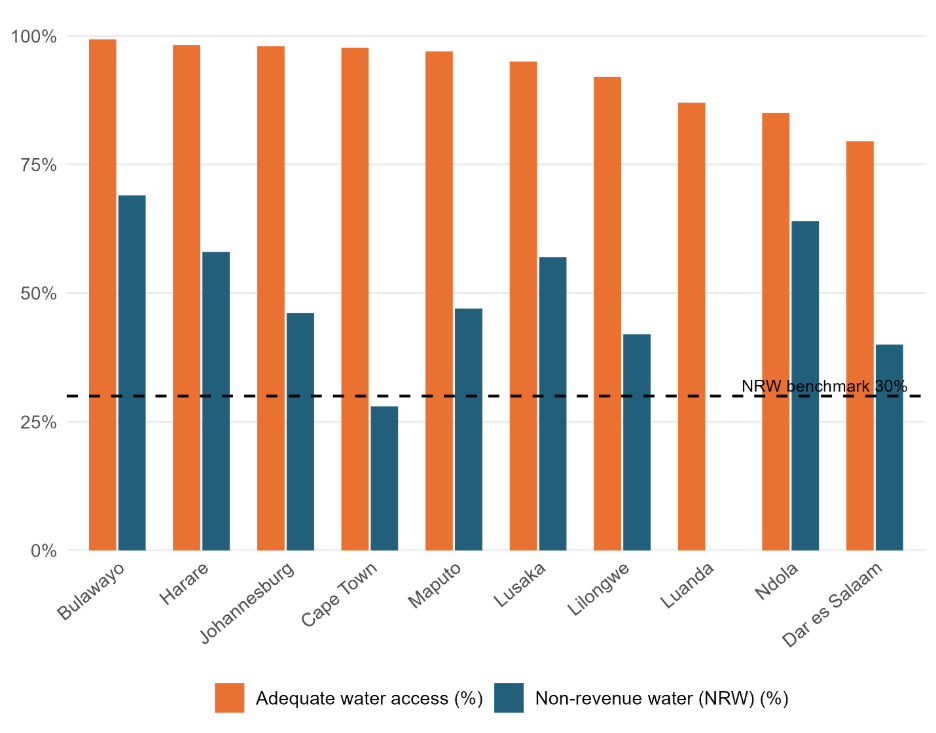
Figure 1: Access to an adequate water supply and non-revenue water (%). Local data sources were used for all cities, with dates ranging from 2021 to 2025, except for Lusaka, which used 2019 data. For NRW, data was available for nine of the 10 cities (Luanda excluded). For eight of these, local sources were used, with data for Maputo taken from the International Benchmarking Initiative (Newbinet.org). The data points span 2021 to 2025, excluding Bulawayo, where only 2015 data were available.
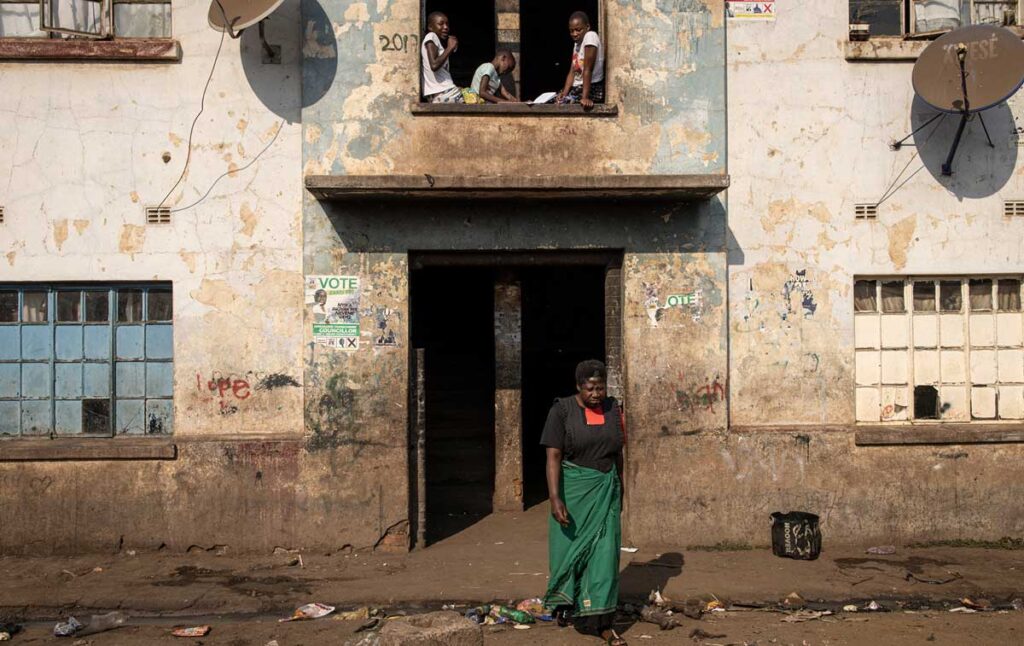
Harare had 98.2% household access to improved water sources in 2022, but it met less than 40% of actual water demand, reflecting both infrastructure failures and population growth that has outpaced treatment and distribution capacity. Non-revenue water stands at 58%, a serious drain on a system already unable to satisfy demand. In informal settlements, access to clean water often depends on proximity to a functioning borehole, with no guarantee of consistency.
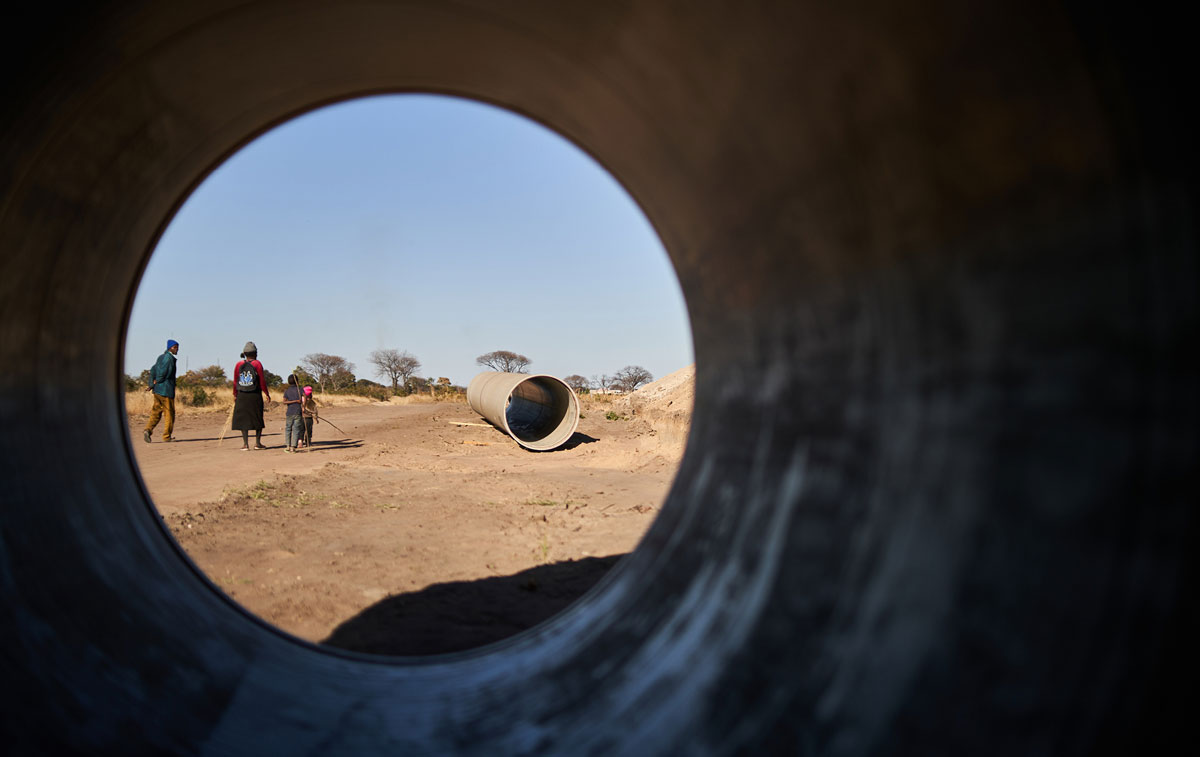
On sanitation, Bulawayo has widespread sewerage connections (Figure 2), but only 30% of wastewater generated actually reaches treatment facilities. The rest often enters the environment partially or entirely untreated. Harare’s sanitation infrastructure is similarly failing, compounded by the informality of much of its residential areas, where pit latrines and uncontrolled dumping are often the norm.
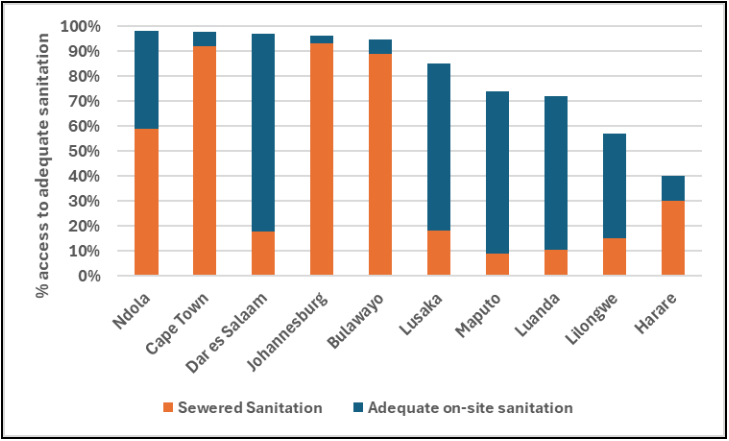
Figure 2: Access to Adequate Sanitation. Data for all cities was taken from local sources, with dates of information ranging from 2021 to 2024, with three exceptions: Harare (2019), Lilongwe (2018) and Maputo (2012).
On roads, more than 87% of Harare’s network requires rehabilitation, a figure already treated as a crisis when the late President Robert Mugabe declared a state of disaster on the city’s roads in 2017. The city estimates it needs $250 million per year for five years to address the backlog, a sum its current budget cannot sustain.
Similarly, road conditions in Bulawayo are poor and in dire need of improvement. The city council notes that 70% of the road network is in poor condition, with more than half requiring immediate rehabilitation. Many of its roads have exceeded their designed service life, making them vulnerable to deterioration, especially after heavy rainfall.
Solid waste management in Harare has also deteriorated to the point that, in 2023, President Emmerson Mnangagwa declared a national state of disaster over the city’s garbage crisis (Figure 3). The city’s refuse fleet is ageing and insufficient, often resulting in illegal dumping, and the capital to replace compactors is unavailable. Bulawayo manages somewhat better, but there too the revenue required to maintain and renew service delivery infrastructure is not being sufficiently generated.
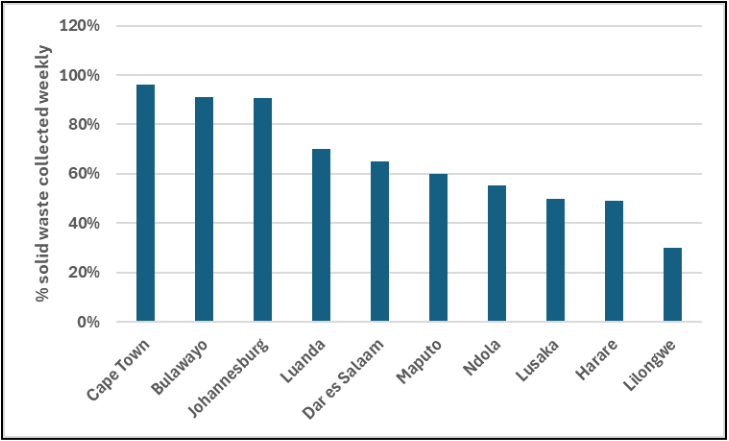
Figure 3: Availability of a weekly solid waste collection service. All the data comes from local sources. The figures for six cities cover the years 2022 to 2024. Harare’s figure is for 2016.
Both councils are locked into a model of self-financing that places the cost of national policy failures onto urban residents. The urban poor, least able to pay and most dependent on functional public services, are asked to sustain services that the state has constitutionally mandated but financially abandoned.
When Harare’s residents reacted with outrage to the council’s proposal to borrow $21 million for infrastructure improvements, it captured, among other things, distrust of an institution that has struggled to account for what it already spends. But the inadequacy of that institution cannot be understood in isolation from the political conditions that produced it.
Benchmarked against other cities in GGA’s 10 SADC sample, cities in countries with more robust intergovernmental fiscal frameworks, including South Africa’s metros and Lusaka, tend to perform better.
The SADC comparison also highlights the distortion introduced by partisan politics in urban-national relations. Where ruling parties control both levels of government, transfers tend to flow more freely, and relations are more cooperative. Zimbabwe is an outlier in the extent to which opposition control of its major cities has often been met with sustained fiscal hostility from the centre and compounded by corruption and institutional incompetence at the city level.
The question at the centre of this article, and at the heart of this issue of Africa in Fact, is whether African cities can move from survivalist urbanisation to something more inclusive and durable. In Zimbabwe’s case, the trajectory will not change without a fundamental shift in how the national government relates to its cities.
At the city level, there is room for improvement. Harare’s revenue collection failures capture institutional dysfunction that stronger billing systems, a competent and right-sized workforce, good governance practices, and more rigorous financial management could address. Bulawayo, with its higher collection rates and slightly better institutional quality score, demonstrates that better performance is possible within the same structural constraints, though it, too, relies on outdated billing systems and could benefit from stronger governance practices.
But institutional reform at the city level cannot resolve a structural problem. “Unfunded mandates”, the assignment of service delivery responsibility without commensurate fiscal support, appears to be a feature of Zimbabwe’s governance model, a mechanism through which the centre offloads policy cost while retaining political control.
What Harare and Bulawayo together demonstrate is that Zimbabwe’s urban crisis is a story of a state that has chosen to treat its cities as administrative inconveniences rather than engines of national development. Reversing that through equitable fiscal transfers, reduced political interference, and sustainable infrastructure financing is the prerequisite for any meaningful improvement. Without it, Zimbabwe’s cities will survive, as they always have. But surviving is a poor ceiling for a country whose future depends increasingly on what happens in its urban areas.

Nnaemeka served as a Senior Data Analyst at Good Governance Africa. He completed his PhD in Applied Data Science at the University of Johannesburg, South Africa, supported by South Africa’s Department of Science, Technology and Innovation. His research applies data science and computational methods to questions of governance, social bias, political attitudes, human development, and disinformation. His work has been published in journals including EPJ Data Science, Journal of Computational Social Science, Social Science Computer Review, Political Psychology, and Politeia. He has also worked as a Data Consultant at DataEQ Consulting and has teaching experience at the University of the Witwatersrand, both in South Africa.