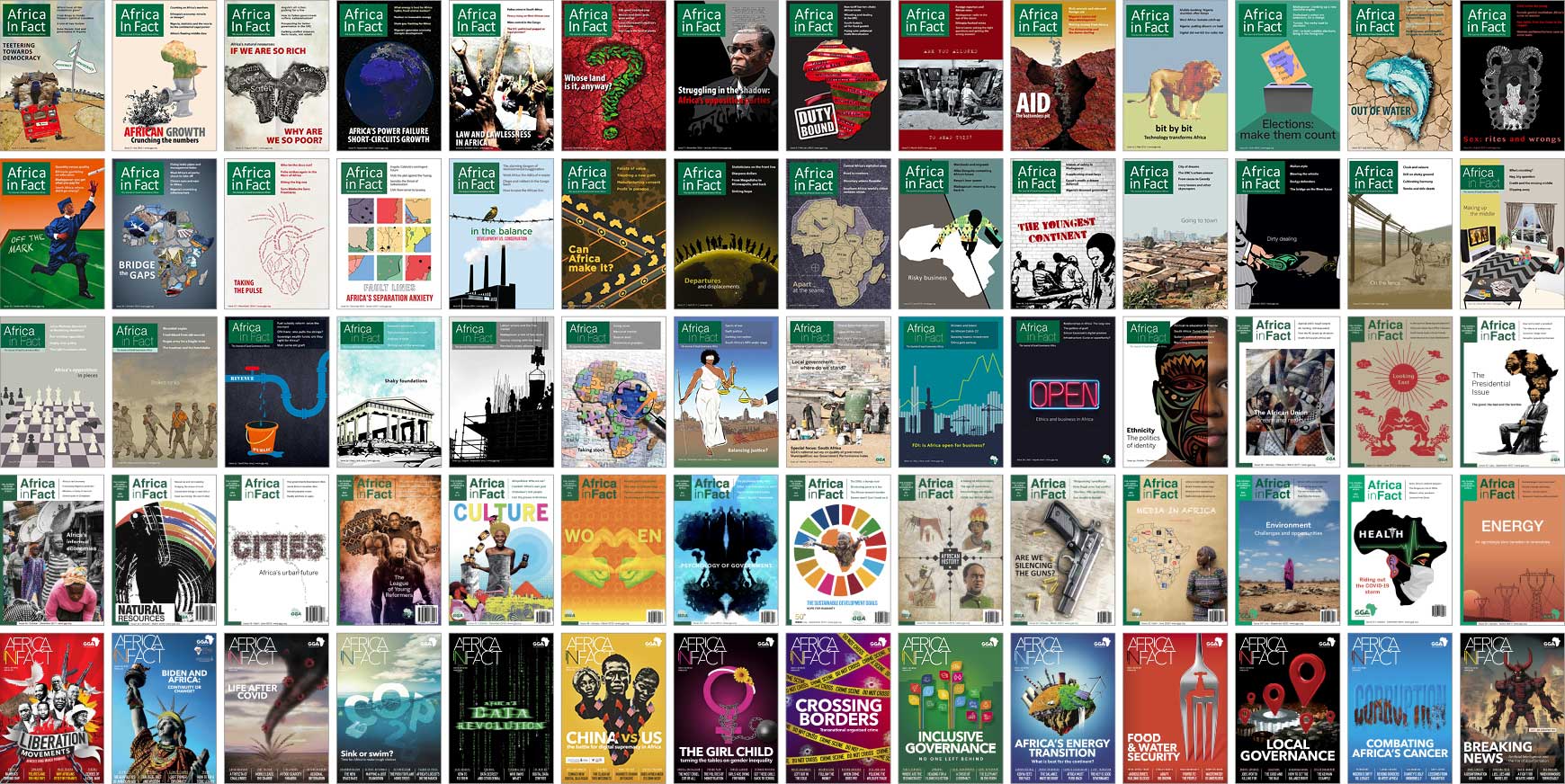
This edition of Africa in Fact seeks to dissect the complex challenges and emerging opportunities for sub-Saharan Africa (SSA) within an increasingly fragmented global order. For the purposes of this issue, we asked contributors to anchor their analysis in the pivotal moment of South Africa’s 2025 G20 presidency, under the theme of Solidarity, Equality, and Sustainability. This milestone provided Africa with an opportunity to position itself as a rule-maker, moving beyond the periphery of global decision-making.
The first G20 held on African soil certainly came at a unique moment of opportunity for Africa, suggest contributors Ronak Gopaldas and Menzi Ndhlovu in their co-authored article. “After years of bad luck, policy missteps, and painful own goals, the tide finally appears to be turning for Africa,” they write. “External and internal dynamics are converging to create a rare ‘positive perfect storm’, one that has caught the attention of global investors and is beginning to unlock a new wave of foreign capital into both financial markets and the real economy.”
Geopolitical factors have materially elevated Africa’s strategic value, they say, as the continent, with 30% of the world’s mineral reserves, is crucial to global transitions in renewable energy, technology and defence.
“As global powers adopt more explicit hedging strategies, Africa’s importance to global value chains and connectivity – maritime, land and digital – has become central to their ambitions. Further, the continent’s demographics, natural resources and geographic position make it simply too consequential to ignore.”
To quote researcher and first-time contributor Nerissa Muthayan, Africa now sits at the heart of an accelerating transition to a multipolar world, spurred on by the US retreat from its traditional role as leader of global multilateralism in favour of Trump’s more transactional and America-first foreign policy. “Africa accounts for a growing share of the world’s population, holds critical natural resources, and represents the next frontier of economic expansion,” she writes. “Yet its influence in global decision-making remains limited, particularly in the institutions that shape financial rules, development priorities, and trade regimes. Few forums matter more in this regard than the G20.
The gravity of the geopolitical shift is underscored by Wits University academic Bob Wekesa, who observes that the 20th G20 summit held in South Africa last year “was the most geopolitically tense since the organisation was established in 1999. These tensions emerged from a spectacular ideological, political, diplomatic, and economic fallout between the United States and the rest of the G20 member states.”
Wekesa argues that the tectonic geopolitical shifts currently underway mean that the proposals touted at the 2025 G20 can be pursued as a means of reforming the post-World War II global order. “We are witnessing a move toward what some refer to as ‘pragmatic realism’, where traditional power structures are bypassed in favour of new, strategic alliances. As the traditional Western-led consensus fractures, African nations have the chance to assert their own agency, leveraging their resources and demographic weight to demand a seat at the table where the new rules are being written.”
It is in this context that GGA Nigeria regional office researcher Adejumo Kabir sets out how Nigeria’s rich reserves of critical minerals, such as lithium, gold, cobalt, and rare earth elements, position it at the centre of the global energy transition and tech revolution. Yet, he adds, the country remains stuck in a cycle of exporting raw materials and importing finished goods. As demand for these minerals surges, Nigeria, he says, faces a crucial question. “Will partnering with global platforms like the G20 help it build domestic industries and break this cycle, or will the country repeat past mistakes?”
Regular contributor Neil Ford says the G20 can play a role in influencing the future of international support for Africa’s energy transition. “The G20 does not finance African renewable projects directly or negotiate fossil-fuel phase-out deals, but it does hold influence over multilateral development banks and helps shape the rules and priorities of global finance.”
Ford points out that the G20 has already helped persuade multinational banks to take on more risk in low-income countries, increase climate and renewable energy lending, and reform capital rules to lend more without raising costs. “In addition,” he writes, “most JETP donor countries are also G20 members, and the idea of a just transition has been reinforced in G20 meetings, alongside the argument that clean energy investment must promote development and energy access, not just emissions cuts.”
So, where to from here? The Johannesburg summit was, to some extent, overshadowed by intense friction between the US and South Africa. Trump and his government boycotted the event, using various grievances against South Africa, including the frankly moronic claims of white genocide. The US behaviour was another example of the administration’s contempt for multilateralism, and it was to the credit of both South Africa and other G20 members that the summit was a success. Wekesa notes that the G20 processes and, eventually, the summit proceeded despite the absence of the US, suggesting that in a decoupling global order, resilience is a trait African countries should nurture.
With the US holding the 2026 G20 presidency, it’s anyone’s guess at this point just what the Trump administration envisions for its Miami summit in December. Wekesa points out in his article that as of mid-February, the G2O US website had no content. The US has also made it clear that it would not invite South Africa to this event, prompting South Africa to temporarily withdraw from the G20 in 2026.
Fortunately for the continent, the African Union has had a permanent seat on the G20 since 2023, and it will be in all our interests for our governments to leverage this in the run-up to December. The AU’s permanent membership will be strategically beneficial for Africa’s continued contribution, especially now in the context of South Africa’s temporary absence.
As GGA researcher Sikhululekile Mashingaidze says in her article, the G20/2026 will be a credibility test for the AU. Wekesa agrees, writing that strategies should include understanding US interests towards Africa and using the G20 as a platform to structure deals beneficial to the continent.

Susan Russell is the editor of Good Governance Africa’s quarterly journal, Africa in Fact. She has worked in the media industry for more than 30 years as a journalist, editor, publisher, and as a general manager. Career highlights include several years working for Business Day and more than a decade as a reporter, editor and General Manager at the Sunday Times in Johannesburg.