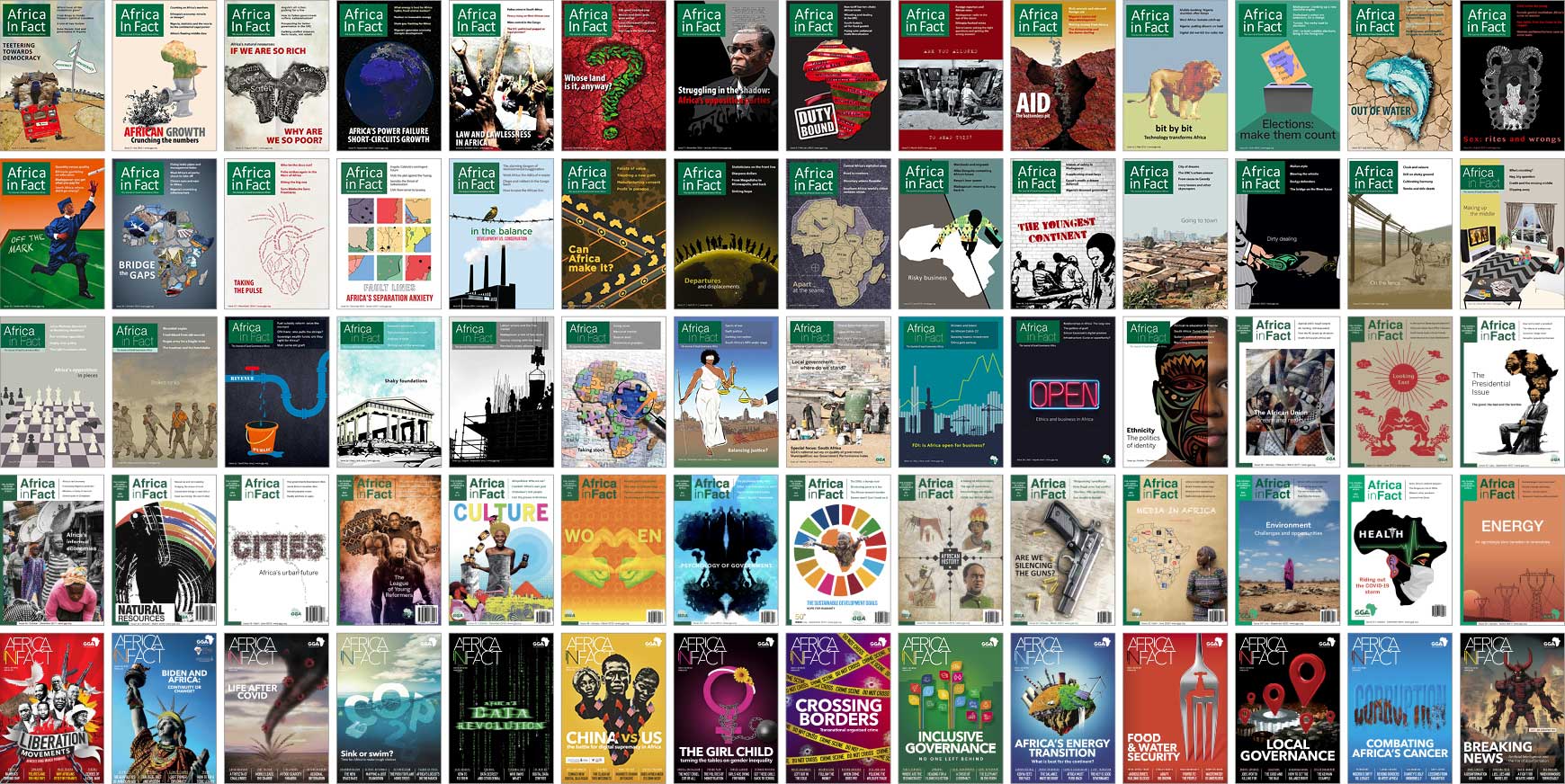
Welcome to this issue of Africa in Fact, which offers a timely examination of the complex and evolving challenges to peace and security across the continent. According to international non-profit Armed Conflict Location and Event Data (ACLED), Africa had the highest level of conflict in the world last year. As this collection of articles reveals, the reasons behind many of these conflicts are layered and regionally specific, challenging easy resolution and raising questions about the efficacy of traditional conflict-resolution frameworks established by the African Union and United Nations.
A reading of the articles published in this issue does, however, suggest several common denominators that, while not peculiar to Africa, are magnified by a persistent history of contestation over dwindling natural resources, bad or no governance by post-colonial elites, and interfering foreign actors with conflicting geopolitical agendas.
In the Sahel, for instance, which has seen an alarming resurgence of military coups in recent years, conflict is driven by a convergence of state fragility, resource competition, cross-border insurgencies, and weak governance. Local grievances – over land, livelihoods, or political exclusion, fuelled with misinformation and disinformation spread on social media – are also exploited by transnational actors, adding to an already toxic mix.
In the Horn of Africa, internal fragmentation in Ethiopia and Somalia, state rivalries, contested borders, identity politics and vested external interests, not to mention the vicious civil war in Sudan between two rival factions of the government – the Sudanese Armed Forces (SAF) and the Rapid Support Forces (RSF) – help to emphasise the need for alternative approaches to conflict resolution. In his overview of the current situation, including attempts to find peace for Sudan, Professor Asnake Kefale says vested external interests continue to sideline African-led solutions. The Horn of Africa region has also become an extension of the Middle East (Afro-Arabia) and a laboratory for power projection for countries like the UAE, Saudi Arabia, Türkiye, and Qatar.
“The Horn of Africa suffers from deep-seated vulnerabilities, including weak and contested governance, economic underdevelopment, recurring droughts, border disputes, and tensions and conflicts over shared resources like the Nile waters. These internal challenges are actively exploited by external powers seeking leverage and advantage, transforming domestic conflicts into regionalised and internationalised crises,” he writes.
Regular contributor Ronak Gopaldas suggests in his article that South Africa should use its presidency of the G20 to make a case for reframing the concept of security, broadening the term beyond military concerns and traditional state-centric definitions. “This framing is no longer adequate,” he argues, “particularly for African states, where security threats are increasingly diffuse, multidimensional, and deeply embedded in social, economic, and environmental fragility.
Gopaldas says that while this does not offer a silver bullet to solve Africa’s conflicts, “it may be one of the few entry points left for pragmatic cooperation in a divided world. And it allows South Africa to align its presidency with both African priorities and the evolution of global dynamics.”
Researcher Erika van der Merwe, meanwhile, asks whether it is time to recalibrate Africa’s security architecture, and if so, what normative and legal frameworks must accompany this shift to prevent entrenching patterns of dependency and personalised security politics?
“Amid mounting criticism of United Nations peacekeeping missions and western military involvement, an increasing number of African governments have sought out alternative security partners,” she writes. “Rwanda’s recent forays into bilateral security agreements mark a significant departure from Africa’s status quo. On a continent where multilateralism and regional cooperation remain the gold standard, Kigali’s deployments to the Central African Republic (CAR) in 2020 and Mozambique in 2021 challenge both conventional norms and institutional habits.”
Brigadier General Tim Ba-Taa-Banah, PhD, a career officer in the Ghana Armed Forces and founding editor of the African Journal of Defence, Security and Strategy, in suggesting a security roadmap for the Sahel, makes the case “for an organic peace regime whose architecture is embedded in local ontologies, knowledge (transmission) systems and ancillary indigenous praxis, anchored on the conviction that sustainable peace cannot be externally crafted and locally coercively imposed.” For peace to be enduring, he argues, it must be generated organically from the self-framed lived experiences of local communities with acute recognition of the basis of “community resilience, cultural assets of solidarity, and historical experiences garnered both in peace and times of crisis”.
One example of a regional security system designed specifically to support peace in a local context is the Southern African Economic Community (SADC) Early Warning system. Security analyst and former diplomat Dr Craig Moffatt, who was involved in its creation, describes how the EWS was conceived in the early 2000s when the region was repeatedly caught off guard. “Political turmoil in Zimbabwe, unrest in Lesotho, and intermittent conflict in the Democratic Republic of Congo (DRC) all exposed the need for a more systematic regional response.”
One of the initial achievements was establishing an indicators-based monitoring system that tracks political, economic, environmental and social triggers, allowing the centre to model scenarios and identify potential hotspots, he writes. Over time, members contributed more consistently, leading to a strong network of national focal points trained across all 16 states.
“Their contributions offered real-time insight into various potential crises,” Moffatt says. “This network has since become the key to compiling early warning assessments.”
Overall, this collection of articles clearly articulates the need for urgent non-military responses to prevent, manage, and resolve conflict across the continent, including finding solutions to triggers such as land, food, and water disputes, youth unemployment, and local grievances that make communities vulnerable to extremists. None of this is easy, especially as the lines between political, criminal, and ideological conflict have blurred and governance is weak or simply corrupt. However, complex peace and security challenges are no excuse for doing nothing. We simply cannot afford to.

Susan Russell is the editor of Good Governance Africa’s quarterly journal, Africa in Fact. She has worked in the media industry for more than 30 years as a journalist, editor, publisher, and as a general manager. Career highlights include several years working for Business Day and more than a decade as a reporter, editor and General Manager at the Sunday Times in Johannesburg.