At the conclusion of South Africa’s G20 Presidency on November 23, 2025, President Cyril Ramaphosa, at the closing ceremony, called for a renewed commitment to multilateral cooperation, characterised by partnerships anchored in shared goals and common humanity.
This was a much-needed call for unity at a time of heightened global tensions and with multilateralism increasingly under siege. The new Trump administration’s America First combative approach to both allies and old foes or countries with competing interests alike has rattled the post-Cold War order, with nations becoming more insular and authoritarian, and relations between them more transactional than cooperative. It is a new era that demands urgent reflection and the requisite action to rescue the world’s rules-based, cooperative order while accelerating Africa’s development.
But an early indication that achieving these goals faces an uphill battle was that Ramaphosa’s speech, which emphasised the imperative of placing Africa’s development at the heart of the G20 agenda, concluded an event boycotted by the United States, the incoming G20/2026 president, amidst diplomatic tensions between the Trump administration and South Africa.
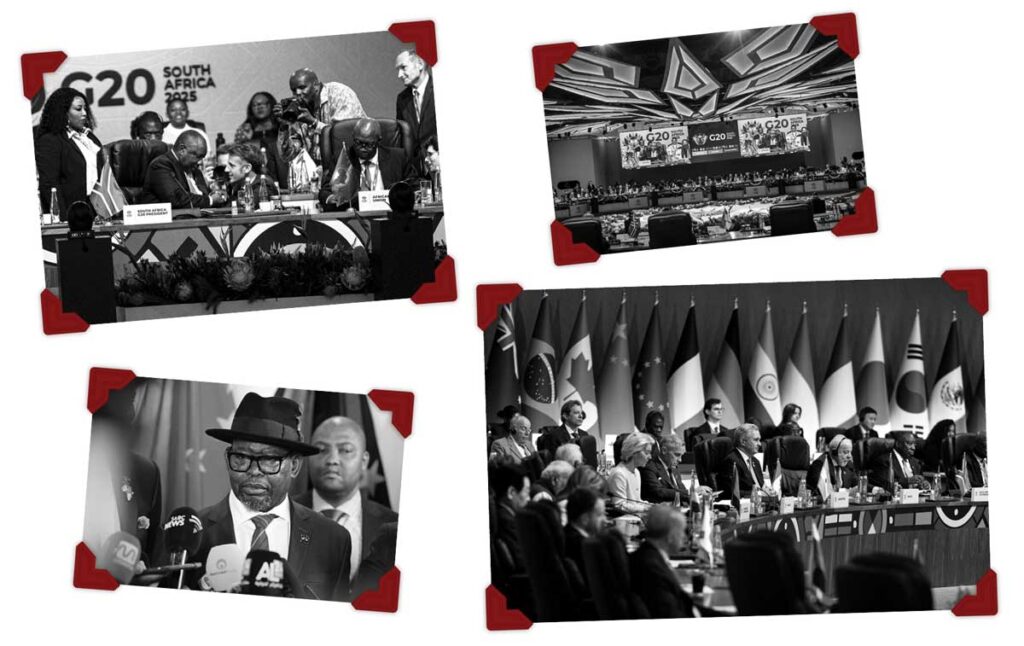
Following subsequent reports that Trump had threatened to withhold accreditation for this year’s G20 from South Africa, effectively excluding the country from participating on US soil, South African Finance Minister Enoch Godongwana, speaking at the World Economic Forum in Davos, announced his country was stepping back from the 2026 engagements due to mounting tensions with the US.
This breakdown is particularly damaging given the G20’s structure. The group uses a system called the Troika, which involves the country that held the presidency last year, the current government holding it, and the country that will have the presidency next. This system is designed to ensure that the work started one year continues into the next; it is meant to prevent the G20 from being a series of one-off meetings. South Africa’s choice to be excused means it will not contribute to the 2026 agenda.
Godongwana, however, gave assurances that Africa would still have a global audience through the African Union (AU), which was officially admitted to the G20 in September 2023. This means Africa now has “formal representation in global economic governance structures, significantly enhancing its ability to shape international policy”, states an AU media release. The AU’s permanent membership will be strategically beneficial for Africa’s continued contribution, especially now in the context of South Africa’s temporary absence.
However, the G20/2026 is a credibility test for the AU, as the sole representative of the African voice. As noted by the Africa Policy Research Institute (APRI), the AU, as a permanent member, may be increasingly vulnerable to the prevailing tariff disputes, rising nationalism, and weakened multilateralism. The AU faces the balancing act of navigating this sensitive global terrain while still attending to its pre-existing, equally critical and pressing political and security crises right in its backyard.

The AU, however, can also meaningfully harness this opportunity by amplifying the coordinated voice of the continent’s 54 recognised sovereign states. Fast-tracking the implementation of its Agenda 2063 is already one of its six key priorities guiding its G20 engagement over the next three years. These priorities will be channelled through three modalities for effective participation: the G20 Leaders’ Summits, the G20 Ministerial Meetings and the G20 Finance Track Meetings.
Another entry point for channelling Africa’s priorities in the G20 is the G20 Compact with Africa, a platform currently comprising 15 African countries. It supports policy reform and fosters African business and investor links to mobilise private capital and localised job creation.
This will be particularly beneficial for Africa’s sustainable youth development priorities. With a population currently pegged at more than 1.5 billion and projected to reach 2.5 billion by 2050, the AU has its work cut out in addressing high youth unemployment and underemployment, among other youth priorities. The continent is home to the world’s youngest population, with more than 400 million young people aged 15 to 35. The AU must be at the forefront of ensuring that this potential is productively engaged. Viable economic opportunities are widely seen to offer a chance to reduce the risk of Africa’s young people falling prey to mercenary and modern-day slave recruiters, as well as other forms of exploitation that currently capitalise on the desperation and socio-economic marginalisation of Africa’s youth.
One of the AU’s key priorities, therefore, via the G20 and other transformative platforms, should be human capital development aimed at harnessing the potential of its young people towards economic productivity and innovation.
A consistent focus on sustainable youth development is a globally shared goal, and beyond the G20 platform it is critical to map out multiple avenues for strategic coordination. Cooperation with other individual countries, regional groupings, and private sector players can go a long way toward fostering a productively engaged youth population that is critical to peace and security, both for Africa and the world at large.
Sikhululekile Mashingaidze entered into the governance field while she was a part-time enumerator for Mass Public Opinion Institute’s diversity of research projects during her undergraduate years. She has worked with Habakkuk Trust, Centre for Conflict Resolution (CCR-Kenya), Mercy Corps Zimbabwe and Action Aid International Zimbabwe, respectively. This has, over the years, enriched her grassroots and national-level governance projects’ implementation and management experience. Her academic research interests are in the field of genocide studies, driven by her commitment to deepening her understanding of girls' and women’s experiences and their agency in reconstituting everyday life, and their inclusion in peace-building and transitional justice processes. Socially, she has a keen commitment to supporting girls' education, women’s economic empowerment and the fulfilment of their equitable and sustainable development in Africa’s underserved, often hard-to-reach communities. She enjoys writing and telling the stories of navigating everyday life.