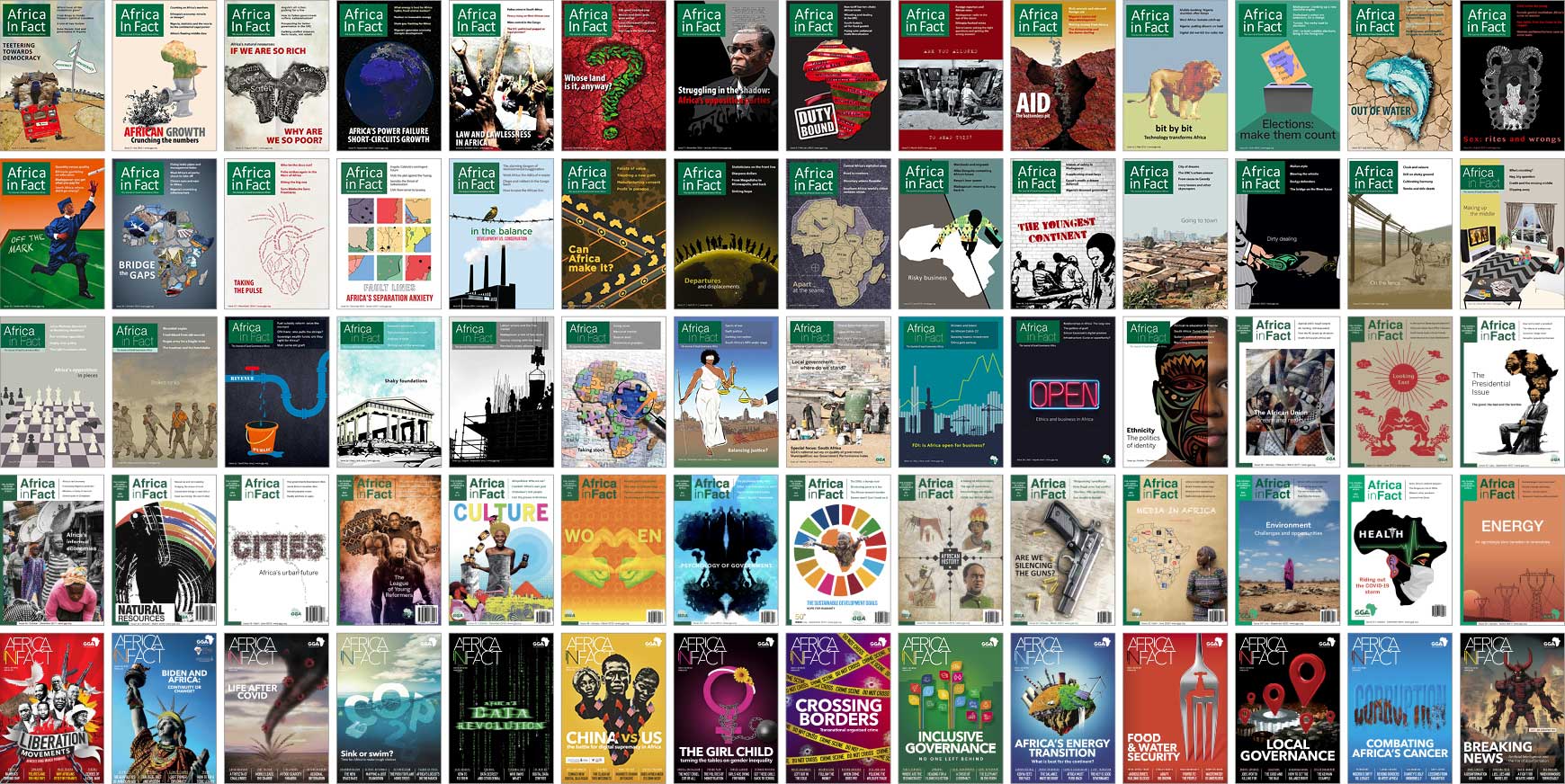

This issue of Africa in Fact asks the question: “Can African cities move from being sites of ‘survivalist urbanisation’ to becoming engines of sustainable, inclusive growth?”
By the turn of the millennium, just under a third of Africans lived in towns or cities. In 2025, this figure stood at 57% and is projected to grow to 62% by 2040. As contributor Terence Corrigan notes, “Africa is adding tens of thousands of residents to its cities daily.” International organisations such as the OECD project that Africa’s urban population will triple between 2010 and 2050, with much of this growth occurring in small- and medium-sized towns.
The articles here are therefore an effort to broaden the scope of our previous African cities issues (April-June 2018 and April-June 2025), which focused more on the continent’s megacities, to try and better understand the dynamics at play in a wider spread of capital and secondary cities and to interrogate how often contentious systems of land tenure affect urban growth.
This issue was also planned to coincide with the publication of all 10 reports that form the first phase of GGA’s African Cities Profiling project, a series of profiles of primary and secondary cities across the SADC region, including Johannesburg, Harare, Bulawayo, Cape Town, Dar es Salaam, Lusaka, Luanda, Lilongwe, Maputo, and Ndola.
The articles themselves reinforce what Beninese architect and former government minister Luc Gnacadja observed about Sub-Saharan African (SSA) cities in an ICLEI (an international network of more than 2,500 local and regional governments committed to sustainable urban development) report he authored in 2022.
While noting their diversity, Gnacadja identified five features common to SSA cities: young populations (on average more than 50% of SSA’s urban population is younger than 18); informal sectors larger than formal (“cities with largely informal housing, economies, and institutions are in practice informal cities, regardless of what policymakers say,” he writes); heightened vulnerability to climate change [particularly floods and droughts] due to institutional and infrastructural weaknesses; and insecurity of tenure, which he describes as a “major roadblock to urban development”.
In the opening article of this issue of AIF, researcher Terence Corrigan argues that “in the absence of proper land markets and the ownership regime that a stable and consistent system of property rights makes possible, the future for the continent’s cities is likely to be ongoing informality, marked by exclusion and insecurity.”
Describing African land and property ownership as a “patchwork of systems”, Corrigan notes that many of our continent’s oldest cities were a product of the colonial era. “Such systems would embody formal, registered title,” he writes. “The indigenous population would generally hold property under customary systems overseen by traditional leaders, a system geared towards a rural population, although as cities expanded, the jurisdictions frequently overlapped.”
The toxic legacy of this arrangement is nowhere more evident than in South Africa, where the apartheid system of Bantustans, or homelands, has left behind large areas of the country (home to an estimated 18 million people or almost one third of the country) where land rights remain insecure and ambiguous. In his article, GGA director of research Dr Ross Harvey uses the Eastern Cape town of Port St Johns as an example of the vicious cycle of underdevelopment that still haunts these areas, where authority is often messily divided between traditional leaders, municipal councils and national departments.
Arguing that rural development requires secure land rights and genuine local accountability, Harvey makes the case that communities like Port St Johns must have real authority over land decisions and municipalities must be central to economic planning, not functionally subservient to chieftaincies.
“Weak local economies produce weak municipal revenues,” he writes. “Weak revenues limit service delivery. Poor services discourage investment. Without investment, employment prospects dissipate. Talented young people, who could contribute either to the economy or provide capable municipal management, leave for the bright lights of the city.”
Elsewhere in this issue, journalist Collins Mtika takes a hard look at his own city, Lilongwe, Malawi’s capital, where he describes how chiefs, city officials, and the politically connected are converting customary land into speculative estates, leaving peri-urban residents with their homes branded “illegal” and their futures erased.
Regular contributor Michael Schmidt, meanwhile, argues that while most urban planning for Africa’s mushrooming cities has focused on megacities and high-value port-and-transport corridors, medium-sized cities, which accommodate a quarter of the continent’s urban population, should also play a pivotal role in development.
Africa’s secondary cities have not been at the forefront of urban policy development and research, he writes, despite playing a critical intermediary role in regional logistics supply chains and sub-national levels of governance, community and social services delivery and economic development.
Other articles explore these dynamics through specific reportage on a diverse range of urban centres, including Dar es Salaam, Bulawayo, Harare, Cotonou, Lome, Johannesburg, Nairobi, and Lilongwe. By examining these locations, the articles highlight how local realities often diverge from national policy frameworks. In cities like Harare and Lome, the struggle for infrastructure development is inextricably linked to the political economy of land, while in Nairobi and Johannesburg, the challenge lies in retrofitting legacy systems to accommodate rapidly expanding informal settlements.
If there is one lesson to be learnt from this collection of articles, it is that urban governance must move from reactive management to planning, and if African cities are to become engines of development, the priority must be on securing tenure, acknowledging the informal workforce, and building resilience into the urban environment.

Susan Russell is the editor of Good Governance Africa’s quarterly journal, Africa in Fact. She has worked in the media industry for more than 30 years as a journalist, editor, publisher, and as a general manager. Career highlights include several years working for Business Day and more than a decade as a reporter, editor and General Manager at the Sunday Times in Johannesburg.