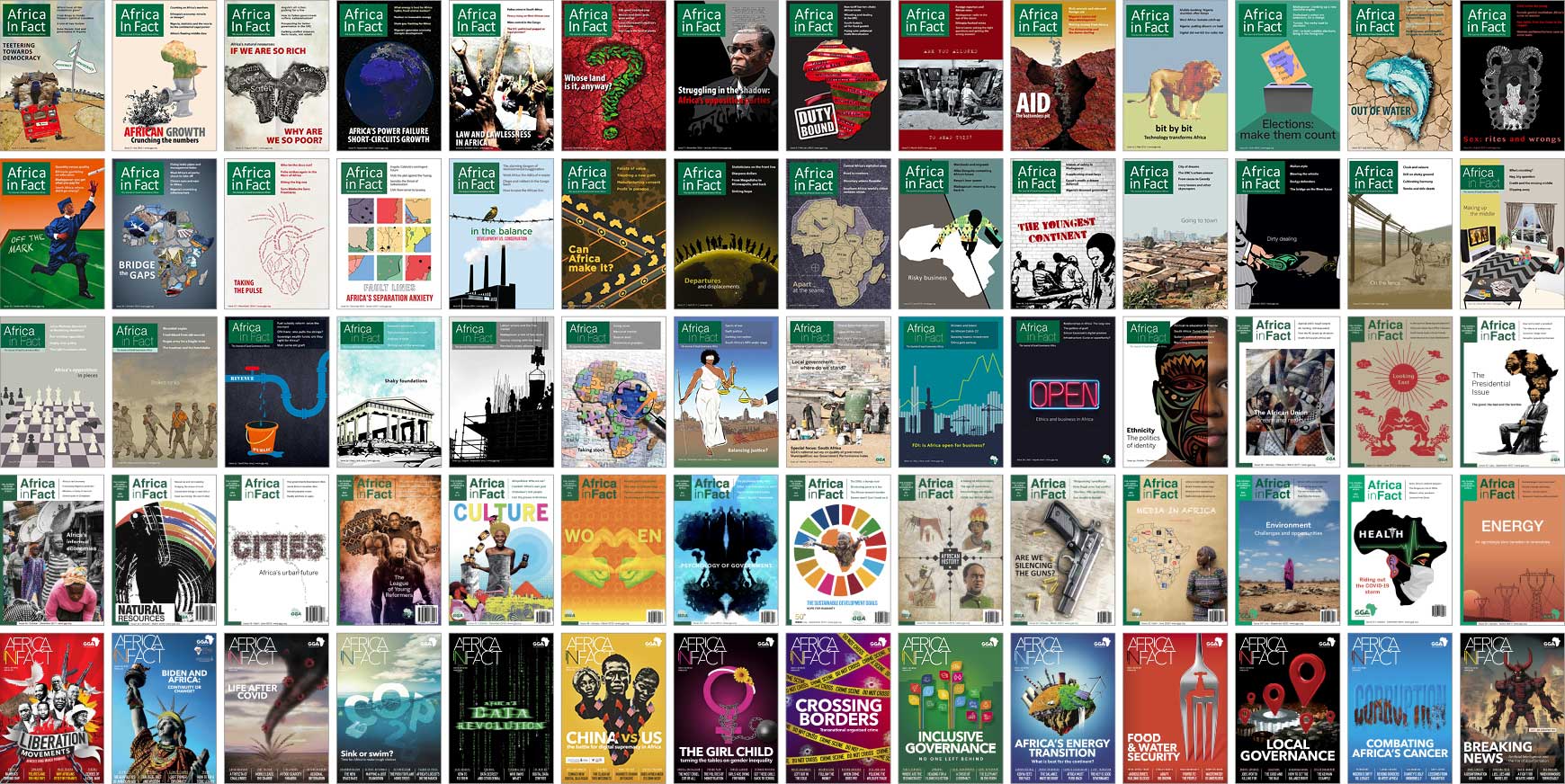
This issue of Africa in Fact looks at the resurgence of coups across Africa, both those reminiscent of old-school military power grabs as well as so-called soft coups – unconstitutional regime changes that vary in form but are arguably very much the same in all but name.
We ask the question, eloquently framed by contributor Ronak Gopaldas, “Why do military seizures of power appear as increasingly viable avenues to contest state authority [in Africa], especially ones in which successful juntas can garner domestic support and international legitimacy?” At least some of the answers to that question and several others are hopefully to be found in the 18 articles published here.
Since the beginning of the decade, Africa has witnessed several unconstitutional regime changes, and in countries like Mali, Burkina Faso, Niger, Gabon, and Guinea, the emergence of hard coups has shattered the illusion of political stability on the continent in the 21st century, generating hard conversations about the state of democracy on the continent overall. Military takeovers in these countries have enabled soldiers to remove civilian governments to the applause of sizeable swathes of their citizens, angered by governments unwilling or unable to deliver the benefits democracy promises.
“The recent experiences of Mali, Burkina Faso, and Niger are instructive,” Gopaldas writes. “The junta-led governments of all three states have not delivered any widespread or meaningful restoration of security or robust governance. Rather, the political space across Bamako, Ouagadougou, and Niamey has narrowed considerably; planned transitions to civilian rule have been put on hold (indefinitely in the case of Mali), and senior military leaders have tightened their grip on power.”
But as Neil Ford notes in his article, “coup leaders generally promise political reforms, greater security, anti-corruption measures and higher living standards, accompanied by a return to civilian, democratic rule. Yet these pledges have largely been unmet in the recent coups.”
The context of this vicious cycle is succinctly described by Comfort Ero, the president and CEO of International Crisis Group, quoted by Gopaldas: “Militaries are stepping in where political classes have run out of ideas, failed to renew themselves, and proved incapable of providing their people with solutions… Accordingly, civilian rule has meant bad rule, and desperate citizens view military rule as a ready-made alternative.”
Africa also has to contend with the insidious phenomenon of “soft coups”, which, instead of military overthrow, erode governance through the practice of third-termism and constitutional manipulation. Both Zimbabwe and Madagascar are examples of countries where leaders have employed strategies to extend their tenures by altering term limits or manipulating electoral frameworks to ensure victory, inevitably leading to instability, the erosion of democratic norms, and a cycle of institutional degradation, setting the stage for military actors to justify interventions.
Three of our contributors, analysts Terence Corrigan and Dr Craig Moffat, and journalist Peter Fabricius, illustrate the damage that soft coups do to governance institutions just as effectively as military action.
Corrigan’s article examines the example of Zimbabwe, where democracy exists in name only, thanks to the practice of third-termism and constitutional manipulation. Moffat and Fabricius both examine the case of Madagascar, albeit through different lenses. Southern African Development Community (SADC) contortions that enabled the organisation to determine that Colonel Michael Randrianirina had been handed power last year rather than seizing it in a coup led Moffat to question just how committed the regional body is to constitutionalism.
“When the military removed Robert Mugabe, SADC and the AU avoided calling it a coup, reframing the intervention instead as a ‘constitutional correction’. The framing was politically convenient – elite consensus existed, and few were inclined to defend Mugabe,” he writes. “By 2025, that precedent had hardened into practice. SADC’s response to Madagascar’s second takeover was notably restrained, with no suspension and no punitive measures, instead only calls for calm and dialogue that carefully avoided assigning blame. What was once unacceptable has quietly become accommodated.”
By contrast, as Fabricius writes, the African Union (AU) quickly deemed last year’s regime change in the country as a coup and suspended Madagascar, which highlights the damage coups, soft or otherwise, pose to the authority of regional bodies, including the AU, the Economic Community of West African States (ECOWAS) and SADC.
The AU maintains an official policy of zero tolerance for unconstitutional government changes, suspending Mali, Burkina Faso, Niger, and Madagascar. Likewise, ECOWAS took a hard line in the Sahel, imposing economic measures, border closures and threats of military intervention. These, however, have had mixed results.
As researcher Erika van der Merwe notes in her article, in the case of Mali, “a single coup regime can be isolated, but a bloc of coup regimes can build an alternative diplomatic identity. As of June this year, Mali’s military regime remains firmly in power under General Goïta, and despite security challenges, industrial gold exports continue to flow and provide a critical economic lifeline to the junta and the security patrons it needs to survive.” In fact, Mali, Burkina Faso and Niger all left ECOWAS after their coups.
So, if there is one lesson to be taken from this current issue of AIF, it is this: Democracy can’t only rely on the mechanics of elections unless they meaningfully improve the lives and livelihoods of citizens. If supposedly democratic institutions only entrench elites and their interests, no one should be surprised when electorates lose their faith in them and grasp at alternatives.

Susan Russell is the editor of Good Governance Africa’s quarterly journal, Africa in Fact. She has worked in the media industry for more than 30 years as a journalist, editor, publisher, and as a general manager. Career highlights include several years working for Business Day and more than a decade as a reporter, editor and General Manager at the Sunday Times in Johannesburg.